A few nights ago, I gave my husband Simon a taste of a dish I was making, one I know he loves. “Did you change the recipe?” he asked. “It doesn’t taste like last time.”
“Maybe. I’m not sure what I did last time.”
“You didn’t write it down, did you?” my husband the CPA said, raising that one eyebrow like he does.
What came out of my mouth wasn’t pretty.
He froze. Almost instantly, I saw I’d overreacted. I wanted to say something to ease the tension. And instead – I started talking about something else.
I’ve always thought of myself as someone who can apologize easily. So, what was going on?
When I slowed down enough to actually look at it, I realized my resistance wasn’t about facing Simon’s response to my apology.
It was about facing myself. Specifically – admitting to both of us I’m someone who sometimes loses it.
Not “I got it wrong, I’ll own it.”
More like: “I thought I was better than this.”
Maybe I’m not as emotionally evolved as I think I am.
THE STURDY PLATFORM OF SELF-WORTH.
The psychologist Harriet Lerner has a framework I keep coming back to. She says that in order to genuinely take responsibility, a person needs what she calls a sturdy platform of self-worth to stand on. From that vantage point, you can look at your behavior and own it – because you can see it as one moment in a much bigger picture of who you are.
But when that platform feels shaky? Owning a mistake doesn’t feel like accountability. It feels like an indictment. Like exchanging who you thought you were for a lesser version.
That’s when the defensiveness kicks in. The justifying. The apology that isn’t really one. The subject changing. Like with Simon.
| I saw the value of a solid apology play out in my work not long ago.
After a difficult stretch with a client, I needed to take responsibility for not delivering what she needed. I sent a short note.
Direct. No over-explaining. Just ownership and what I was going to do about it.
Her response:
“That speaks to your integrity and why I value working with you.”
WHAT AN APOLOGY ACTUALLY LOOKS LIKE.
A good apology is short. The longer it gets, the more it serves the person giving it rather than the person receiving it.
It doesn’t over-explain. The moment it starts sounding like a legal brief, it stops being an apology and starts being a defense.
It isn’t a take-back. “I’m sorry I did X, but you have to understand Y…” The but cancels everything before it.
It names the impact. Not just I’m sorry – but sorry for what, and some acknowledgment of how it affected the other person.
It doesn’t wait for the other person to go first.
THE REAL COURAGE.
When I finally said the hard thing to Simon later that night, it took thirty seconds. We moved on easily.
But getting there required something that sounds small and isn’t: being willing to be the kind of person who sometimes gets it wrong.
Not as a permanent identity.
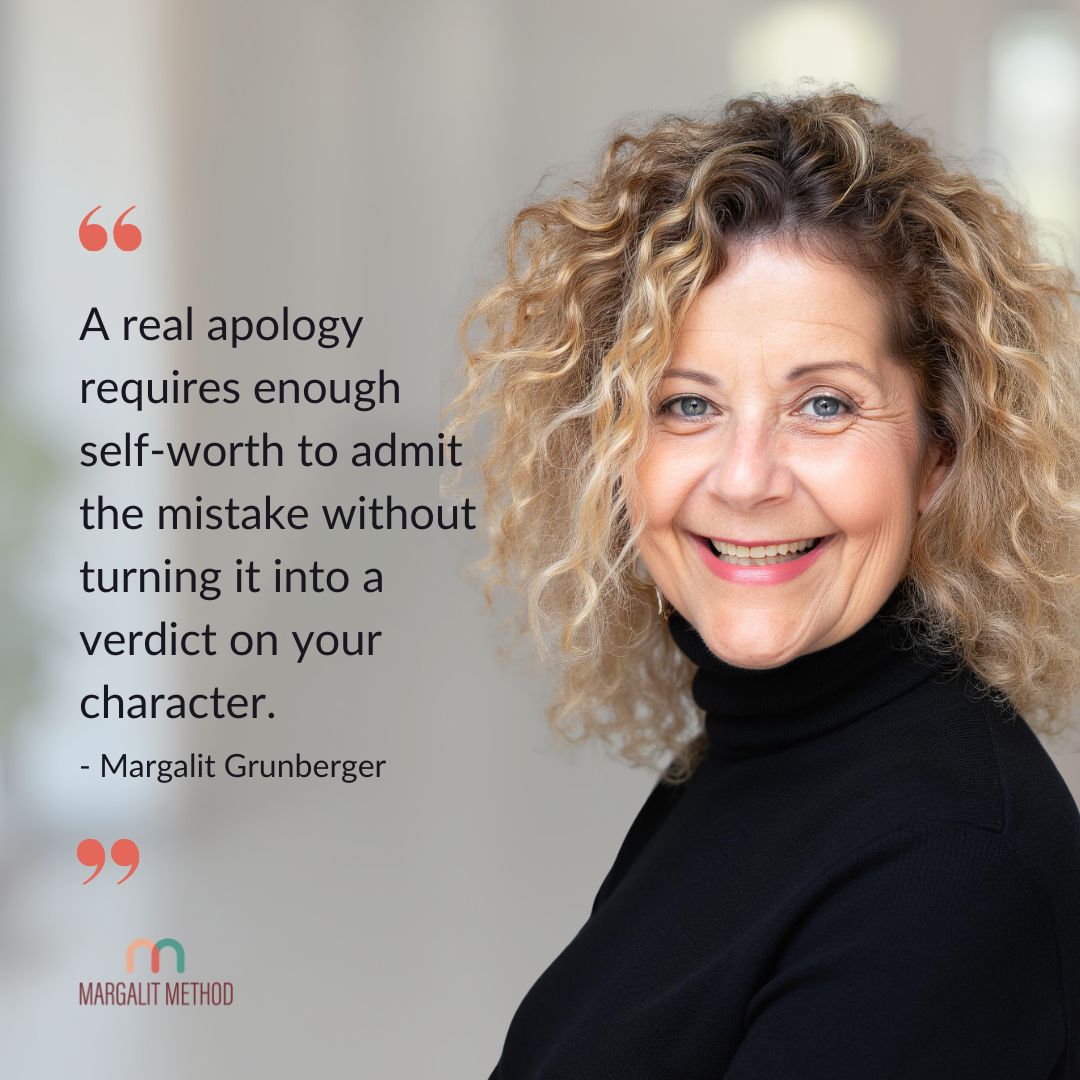
Not as a verdict on my character.
Just as a fact of being human and in relationship.
That’s the inner work underneath every apology. Not just can I admit I was wrong – but can I hold that admission without collapsing into shame about who I am?
If you find yourself avoiding an apology – with a team member, a partner, a peer – sit with that question.
Not what will they think of me?
But what am I afraid it says about me?
The answer to the second question is usually where the real work is.
If this resonated and you’re curious about working together, I’d love to connect. Book a call here. |
|
Until next time,
Margalit |
|