
Dr. Edith Eger died last month. She was 98.
She was one of my treasured teachers – a psychologist, a Holocaust survivor, and the author of The Choice, a memoir about what she learned in Auschwitz that became an international bestseller.
If you haven’t read it, the short version is this: that even in the most inhumane conditions imaginable, no one can take away what you put in your mind. The inner world is the foundation for how we experience everything in life.
On the cattle car to Auschwitz, not yet knowing what was coming, Edith’s mother pulled her close and said:
“We don’t know where we’re going. We don’t know what’s going to happen. Just remember, no one can take away from you what you put in your mind.”
When Mengele forced Edith to dance for him in the barracks, she danced – and in her mind she was on the stage of the Budapest Opera House. She wasn’t pretending or denying what was happening. In her mind, she chose to live somewhere else entirely so that she could give her best to that monster and survive.
When I first listened to Edith’s audiobook, my heart nearly stopped. I had to pull over.
She sounded exactly like my mother. Same accent. Same cadence. Same laugh. Two women named Edith, both born in the same city in the late 1920s, both sent to Auschwitz, both survivors.
And they held the same belief, expressed in almost the same words.
My mother didn’t write a book. She had a phrase she repeated often to me:
Margalit, don’t worry. I’m training my brain.
She said it when things were hard and when she was scared. She said it like it was the most obvious thing in the world – because for her, it was.
She wasn’t a student of psychology or neuroscience. She had survived things I will never fully understand, and she made it through with one unshakeable conviction – that she had a say in how she met her life. Not control over what happened. A choice in how she experienced it.
I remember my parents arguing over their difficult business partner and what to do about him. They were yelling, my mom was in tears and I was scared. At some point she looked at me and said: “Margalit, don’t worry. I’m training my brain.”
I knew that was her shorthand for: no matter how awful this looks right now, I’ll figure this out and we’ll be OK.
Two women named Edith. Same era. Same discovery, made in the darkest possible classroom.
And miraculously, one of them was my mother.
I’ve spent most of my life practicing and teaching what my mother taught me.
And here’s what I know after years of working with founders and leaders: the ones who navigate difficulty best are not the ones who feel it least.
They’re the ones who have learned to work on their inner world the way they work on everything else.
They’re not bypassing the hard thing or reframing it into something it isn’t. They’re asking another question entirely: how can I think about this situation differently?
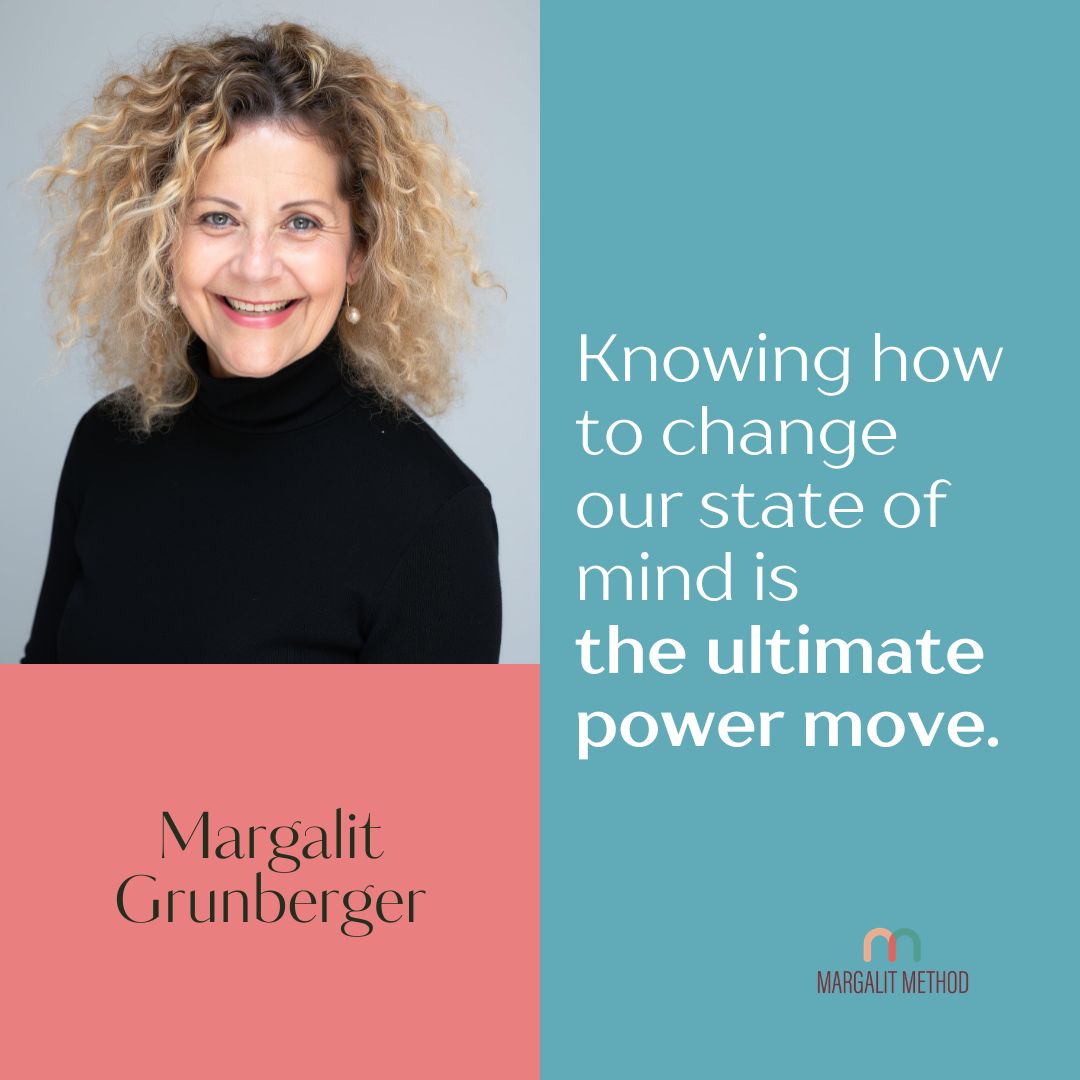
Knowing how to change our state of mind is the ultimate power move.
We’re not reliant on what’s occurring around us, we get to make choices on how we want to respond.
What’s best for this specific situation?
Talk about a power move – try training your brain and see what kinds of challenges you can deal with more ease, confidence and clarity.
My mother didn’t call it a leadership practice. She called it survival.
So here’s what I’d ask you: What are you trying to think your way through right now that actually requires a different state of mind first?
Until next time,
Margalit